
Starting from my favourite at number one, down to my least favourite. Here are five films that are notable for heavy post production, that I personally feel excel above the rest. So, to begin my number one choice...
1. Star Wars Episode III: Revenge of the Sith
What can I say, this is hands down the best visual effects movie about. Shot entirely with Sony HDC-F950 cameras, the image quality and fidelity are outstanding at an RGB 4:4:4 output. This provided ILM with a more efficient post production pipeline, with increased flexibility. From the opening battle above Coruscant, to the final Vader VS Obi-Wan, Episode III is pure mastery.
2. Casshern
Released in 2004, Casshern is a Japanese film directed by Kazuaki Kiriya, and is noted as being one of the first feature length films shot on a 'digital backlot' (Where sets are entirely green screen). More notable as a visual design peace, Casshern disappointed many expecting a fully fledged action film, and instead delivered a moving tale of the impact war has on the human spirit. A rather miniscule team of 1 Flame operator, a handful of 3D animators spent less than 1 year on post production, with the director handling producing and editing details also. For the amount of time they had, it's an impressive VFX package, and one of my all time favourite movies.
3. The Matrix Revolutions
The final piece in the Wachowski Brother's philosophical study into the nature of reality, and man's relation to machine. To most viewers it will simply remain a confusing action movie, but to the fans who delved one level deeper, discovered such complexity and symbolism that it's still debated and dissected to this day. From the get go, The Matrix series created innovations in VFX technique, with Revolutions sitting on top as a brilliant achievement in 3D + compositing. The machine swarm scenes during the battle of Zion were simply breathtaking.
4. Minority Report
Our favourite Scientologist Tom Cruise impresses yet again, in Spielberg's brilliantly paced Minority Report. Subtle to grandiose VFX, produce an entirely plausible future for human technology. From holographic newspapers, to interactive visual panels, ILM created some brilliant shots. It's an exciting mystery thriller and remains one of Spielberg's best.
5. Transformers
I loved Transformer toys as a child of the 80's, and the announcement that this film had gone into production set my mind racing with memories of dreams about to come true. Boy were they shot down in a fiery blaze of disbelief. Michael Bay's Transformers has got to be one of the worst movies I've ever sat through, but contains some of the most impressively composited 3D I've ever seen! Seriously, this stuff borders on photo realistic. Again, ILM pulled out all the stops on this one. But, that's a far as the praise can be stretched. It's still an amazingly stupid, un-exciting, pile of celluloid bollocks. The shame.
So! There you have it! Coming soon, my top 5 films with tastefully subtle VFX!
Friday, March 28, 2008
Keith's Top 5 Modern VFX Heavy Films.


Thursday, March 27, 2008
More from the wonderful world of 3D Cinema
The Math Starts to Make Sense
The HPA Retreat took place with two groundbreaking new 3D concert films in theaters — U23D doing solid business in a few dozen theaters, and Hannah Montana/Miley Cyrus: Best of Both Worlds Concert Tour doing absolutely phenomenal numbers in a few hundred. And while those two releases may seem like an anomaly in 2008, 3D will be a common multiplex technology by 2010, Disney's Chuck Viane underscored that point by showing a list of upcoming 3D films with release dates, including the Toy Story trilogy (reissues of the first two films in '09 and '10 leading up to the release of what may well be titled Toy Story 3D). "3D shifts the filmmaking process more toward post," Viane observed, noting that 3D introduces numerous opportunities to manipulate the way depth is perceived by audiences after the fact of principal photography.The 3D "super session" that opened the HPA Retreat took place at a local multiplex with stadium seating and a generously proportioned, 60-foot screen lit to a little more than four foot-lamberts by a single projector. That's still a small fraction — just about 30 percent — of the brightness generally specified for 2D exhibition (14 foot-lamberts) but for 3D on a screen of that size, it's a breakthrough. The installation of a new "light doubler" from Real D made the difference — but not without introducing some new potential issues for 3D post-production. H. Loren Nielsen, co-founder and president of Entertainment Technology Consultants, noted almost as an aside that, as screens get bigger, so does the actual parallax between projected left-eye and right-eye images that provides the illusion of depth. "That implies that ... we have to master for different screen sizes," she said.One limitation for 3D's expansion, according to Millard Ochs, president of Warner Bros. International Cinemas, is that the perception within the studios themselves is that 3D movies are necessarily animated films. But he said the fast-approaching golden years of the baby-boomer generation represents an unmissable opportunity to reissue live-action films in 3D. "There's a lot of archive material in there. Start taking a look at it," he urged. The point was underscored by a brief demo reel shown by David Seigle from In-Three, which has in years past exhibited compelling "dimensionalized" footage from the original Star Wars film (although an announced theatrical release never materialized). This year, In-Three showed footage from Star Wars: Episode III - Revenge of the Sith and the 1978 zombie classic Dawn of the Dead. (For more information, see Seigle's white paper on "depth-grading." [PDF])Max Penner, a co-founder of Paradise FX, also underscored the importance of broadening 3D's appeal away from kid flicks and special-interest documentaries. He described the tapeless 3D workflow for Dark Country, a low-budget thriller directed by Thomas Jane, which relied on Final Cut Pro, After Effects, and Iridas products. “I applaud all the higher-end philosophies, but we have to have that lower-end content,” Penner said.
Cost Analysis
So you want to shoot 3D. It'll cost you — but maybe not as much as you think. Buzz Hays of Sony Pictures Imageworks offered a cost analysis of 3D production. For a CG animation project, Hays said, 3D will add between 8 and 15 percent to your below-the-line costs. The first three projects done by Imageworks came in on the high end of that scale mainly because they weren't created with 3D in mind; Beowulf, which was produced in 2D and 3D simultaneously, came in at about an 8 to 10 percent premium, Hays said. (Later in the day, Jim Mainard from DreamWorks Animation expanded a little, noting that rendering becomes about 30 percent more costly on a 3D film, adding something like $2 million to $3 million to rendering costs on a typical DreamWorks animated project.)On a live-action shoot, the production premium jumps to anywhere between 15 and 25 percent of below-the-line costs, although that's expected to drop, Hays said. "The real cost is the impact on your shooting schedule," he noted.Finally, creating a 3D version of an existing 2D production will run somewhere between $75,000 and $125,000 per minute, Hays said. Obviously, this tactic will make sense for some types of content, but not for all of it.Once you know how much it all costs, how do you figure your chances of recouping? Well, the market is still nascent, so even though there are finally enough 3D-capable digital cinemas in the U.S. (about 1000) for a given 3D project to make money without a 2D version released in parallel, don't expect miracles in the short term. "Does the business model work?" asked Peter Dobson, CEO of Mann Theaters, thinking about the investments required by exhibitors to keep these movies on 3D screens — which tend to be larger auditoriums — even as admissions drop steadily following strong opening weekends. "So far, no." The release of 10 3D movies in a single year's time, Dobson said, "would just about make it work."But as long as the exhibitors can figure out how to show the movies, studios are starting to get excited about making more of them. Don Tannenbaum of Warner Bros. noted that $35 million of Beowulf's $82 million domestic box-office haul came from 3D engagements, representing 3.9 million admissions. The studio reaped $7.8 million from increased ticket prices for the 3D version, and estimates that it generated about $22.5 million in incremental revenue — that is, money from patrons who would not have seen the film at all if it were released only in 2D. That's a lot of money to leave on the proverbial table, so expect 3D production to ramp up over the next few years. Hays said "the floodgates will open" in 2009, when a new release is scheduled roughly every six to eight weeks.
Behind the Scenes for Hannah Montana
Representatives from Quantel and Fotokem were on hand to show clips from the Hannah Montana film, which was captured with 14 cameras on seven stereo camera rigs. Fotokem relied on Quantel's juiced-up, 3D-enabled Pablo for immediate playback of stereo footage as well as the ability to work on both left-eye and right-eye footage simultaneously. “Being able to lift, cut, trim, slip and slide whilst you've got the glasses on is huge,” said Quantel's Milton Adamou. For Hannah Montana, Adamou said, it was still necessary to ingest one eye, then the other eye, and then marry the two in the Pablo. But the latest version of Quantel's product allows reading both eyes in 4:2:2 via dual-stream output from HDCAM SR tape. In the future, it should be possible to ingest camera metadata along with the footage. "There's no standard for this," Adamou warned. "We're still wrestling with where to embed this in the DPX header."Fotokem started work on Hannah Montana/Miley Cyrus on November 1, according to Senior VP of Technology Paul Chapman, with a goal of DCP delivery in January. He stressed a few lessons learned from Fotokem's experience in those 3D trenches: it's important to look at all your material for both eyes to see any problems early in the process. 3D convergence — the term generally refers to tweaking the image to move objects forward and backward on the Z axis — needs to be reviewed in the context of the edit to make sure the shot-to-shot flow is pleasing to viewers. It's important to work live — to be able to see the effect of changes in 3D as you make them. And, if possible, it's a very good idea to test your DCP in a real venue to avoid unpleasant surprises later.
Making the Grade in 3D
In the HPA demo room, Palmer was manning a demonstration showing Iridas Speedgrade DI working in full 3D mode with footage from Dark Country (shot with cameras from Red and Silicon Imaging) playing back on a 120 Hz Samsung LCD screen.Much grading work can happen in 2D, but the difference in the image once you put on a pair of active stereo glasses is dramatic. For one thing, the amount of light that you see through the glasses is reduced, meaning that a color-grade that looks overly harsh or washed-out in two dimensions suddenly looks moody and dramatic when you pop on the glasses. It's easy to imagine colorists making decisions to bring color saturation up or down depending on a particular object's position in Z-space.
Too Much Too Soon?
Is there any downside to 3D exuberance? Wade Hanniball, VP of cinema technology at Universal Pictures, took a more cautious tack than most, arguing that managing a comprehensive move to digital cinema, of which 3D is only a subset, is still the most critical task. If the industry swoons for 3D in the coming years, Hanniball warned it could take its collective eye off the more pressing issue — a complete, rather than piecemeal, digital transition. "Stop saying 3D will be the savior of the theatrical business," Hanniball urged. "Fundamentally, it isn't in need of saving. Theaters need to compete on long-term quality of service, not on the temporary uplift 3D may grant. ... Let's not let 3D distract us and take the focus away from the advantages of 100 percent digital-cinema conversion."Universal plans digital releases of its entire 2008 theatrical line-up, save In Bruges, Hanniball said.
Wednesday, March 26, 2008
FxGuide - The Third Dimension
FxGuide has a fairly comprehensive feature story and podcast regarding the increase in demend for stereoscopic films, and what that means for post production, including a brief summation of the theory and relevant applications.
In particular, a link to the blog of 3D specialist, Lenny Lipton is well worth a look.
http://www.fxguide.com/article471.html
http://lennylipton.wordpress.com/

Ultra Hi-Res art


Check out these works of art by Chris Jordan - the exhibitions dubbed "Running the Numbers"
Imagineer Systems Update
Expensive.
Imagineer Systems Launching VFX Architecture mogul at NABModular Desktop- and Systems-Based Solutions unites Editing, Compositing, 3D Design and Finishing in Open ArchitectureMatt ArmstrongMarch 20, 2008 Source: Studio DailyFor many years the finishing and VFX realm has been dominated by Autodesk and Quantel. Well, there’s soon to be a new option for high-end work as Imagineer Systems will soon launch mogul, an open, collaborative architecture integrating visual effects systems and desktop applications.
At the core of the mogul architecture is an open platform that connects all the tools in a facility, tracks the workflow, alerts artists of updates and reports the progress of all projects. While Imagineer will roll out new individual products as part of mogul – ranging from a rotoscoping tool to a fully featured, systems-based mastering suite – the open architecture allows facilities to plug existing tools from other manufacturers into this platform to leverage the workflow. And all of the mogul products will be offered solely on by monthly subscription.
We spoke with Allan Jaenicke, chief executive officer of Imagineer Systems about mogul, why Imagineer Systems ventured on this enormous undertaking that it is betting will be powerful enough to challenge the systems-based finishing systems from Autodesk and Quantel, as well as a variety of popular desktop applications.
What were the reasons to embark on this venture? ALLAN JAENICKE: A lot of it had to do with changes in the business. If you looked at the last 20 years of post we had these golden days of the 90s where you had these hugely expensive dedicated hardware solutions. Then those were replaced because we needed faster response and more creative tools. So Discreet was able to come into the market with a model of a hero suite but with more commodities in hardware with big Silicon Graphics workstations. What facilities are looking for now is a much more open system. They need this single hero suite but they also need to be able to work better together across various departments.
One thing customers pointed out is there’s a huge gap between the 3D department and the high-end 2D departments and finishing departments. Traditionally, if you have a desktop work group using Maya maybe doing some pre-comps in Shake or Fusion to try out the output on the 3D application, most of these facilities do not bring these raw renders from 3D into a high end system like a Flame. They re-do all the composites because Shake and Flame obviously don’t talk very well to each other. There is a big gap there. Then you have the people in the 3D department who are used to working with 32-bit floating at any resolution, etc. A Flame or Quantel, for example, are not able to handle that bit depth and all those other variables. So that makes the 3D department hesitant to hand work over to the high-end finishing guys because they feel that they don’t have the toolset to deal with the high-end material and the high-end finishing guys don’t trust the 3D guys to do their compositing.
Essentially gaps like that are the gaps that we are looking to bridge where people work with different toolsets and hinder the workflow. At the core of all this is budget pressure on facilities. Now facilities are asked to do more sophisticated work in less time with lower budgets. Having gaps between different departments and miscommunication, files that need to be copied and work that needs to be re-done is really what slows production down.
So mogul is not just a finishing system?AJ: We decided to step away from the idea of creating a just high-end finishing system and instead we designed a completely new platform that facilities could work off. This platform includes a number of different products that fit onto that platform. One of these products is a high end finishing system (mogul/master) - a combined hardware and software solution that gives you essentially 3D rendering engine for doing compositing, paint, I/O, all the things you would expect in a high end finishing system.
On the other hand, part of the platform is a series of desktop products So what you have is a workflow module that ties all of this together so if you a person doing rotoscoping when he is done the output he creates is immediately shared with the high-end finishing artists. So the high-end finishing artist can have the other artists feed him assets in a very efficient manner without having to copy setups of recreate things and sending emails back and forth with notes. It’s this concept of this platform that not only gives you this tool but also this environment within which you can communicate.
So this platform isn't just open to the mogul products?AJ: It’s a very open system. Anything can plug into it. It gives you a server that runs and manages all of the media and all the metadata. One of the issues facilities run into is that if they just have free access to shared storage then it’s just a big free-for-all with no control over how people name things and where the latest version is located. In a mogul setup, at the core you have shared storage but you wrap that shared storage in a storage management system that we call out mogul/serve product. That product is a server that essentially gives different people access to the media and also the metadata and is the hub that allows all this collaboration and sharing. So, for example, you could connect the mogul/roto into mogul/serve but you could also connect and Apple Shake or Eyeon Fusion via another application called mogul/browse, which gives you the ability of hooking third party applications into that system. So it gets you away from having a disk that everyone randomly writes media, and only media, and we are wrapping that storage in a server that gives access privileges and associates the media with the metadata.
Talk about mogul/review.
AJ: The producer sits down with the client, the client decides to make a comment about frame 5 in clip 10, he can make notes about that frame and hits Save. When he saves it that information is immediately sorted on the server and the person on the mogul/master system immediately gets that not popping up. So rather than notes and email to the artists who then has to go onto the system, find clip 10, the system deals with the collaboration so the artist can simply see the notes, open it and make the adjustment.
Explain the mogul/master system. What products can it be compared to and what is different about it?AJ: It’s similar to an Autodesk Flame, Inferno or Quantel iQ. High performance, complete finishing system, composting, editing, grading, etc. One of the interesting things about the mogul/master system is the way we’ve been able to very closely integrate editing compositing and grading so you can seamlessly transition between those toolsets without ever having to render to go out to another tool. Other tools out have tried to bring those things together but are not truly integrated, you can’t switch between them without encountering some sort of roadblock.
The desktop tools are completely new applications? mogul/roto is not Motor? AJ: They are completely new apps. We started with a completely new technology behind these products. So we’re giving ourselves a fresh start with all of this technology written from the ground up, building on what we’ve learned over the years.
What are Imagineer’s plans for existing products? AJ: We’re looking at an attractive way of transitioning for existing customers from the Imagineer tools they are using now over to the new ones. We’re not discontinuing the other products but we are offering these new products with better functionality.
All the modules described in the mogul platform, whether it is the mogul/server which gives you particular workflow or the individual tools like mogul/paint, you can buy at any time. You can enhance your existing workflow and setup as you need and in the timeframe you want. Obviously we want to give facilities flexibility to grow with us over time.
One of the nice things is that if you hire a junior artist out of college to do rotoscoping, you can teach them that interface and once they know that that they probably know 50 percent of the interface for doing the tracking. Once they learn that they probably know 50 percent of the mogul/paint application. Then he learns that and he knows about 50 percent of the mogul/comp application and once he’s mastered that he knows 50 percent of the mogul/master system. So there’s a nice career path to follow through that system and will save companies a lot of money on training.
Pricing? AJ: These systems will not be for sale, they will only be available on a subscription basis. For a monthly subscription fee you can get the hardware, the hardware maintenance, the software and the software maintenance, everything is included. One thing we found is that big capital expenses are difficult especially for the small- and medium-sized facilities.
Another issue is unpredictability of what costs will occur in the future. Many times when a new software version comes out it no longer supports the old hardware because that old hardware just doesn’t cut it. So the customer is faced with a large upgrade bill for hardware. So in our subscription model we are planning on giving facilities hardware upgrades every year and probably every three years completely switching out the systems. So there’s no big capital expense to get in and customers can predict exactly what their expenses will be.
While that also has benefits for the customers it benefits us as well in terms of developing the products because we can constantly focus on the latest versions of the software and not have to support the last three versions of the software. Typically you have to have a team of engineers on staff dedicated to software we designed years ago. So we can focus on being innovative. Same goes for the hardware. We don’t have to maintain backwards compatibility when we come out with new software and hardware updates. So we can manage that whole hardware and software upgrade for them so they don’t have to worry about having their own engineers trying out different combinations of hardware and software.
Some people have looked forward to software-only versions of products, but often that just shifts what that company’s software and hardware integrators off onto the customers with no significant cost benefit. At the end of the day I don’t think that is what creatives want. They just want to be storytellers and not be reliant on engineers to solve their problems. I think the days are number where facilities can afford to do their own engineering departments. That’s probably one of the things they will realize they have to scale back on to remain competitive.
Do you have any specifics on the prices? AJ: Nothing final. Basically we looked at the cost of ownership, including upgrades and maintenance to similar products on the market and divided those figures to come up with the pricing. So the roto tool may be as little as $25 a month and the master system may be $10,000 a month. mogul/review will be around $1,200 a month, mogul/serve and browse starts at around $3,500 a month [for 10 mogul/browse licenses].
What will be shipping at NAB and what is the timeline for release of the other products?AJ: At NAB, that will be shipping at NAB will be mogul/serve and browse and review. Every five months we are planning to release a new set of products. The order of release is yet to be determined. Over the next year to 18 months we will have a fully featured platform in terms of all the products
http://www.studiodaily.com/main/news/headlines/9185.html
Tuesday, March 25, 2008
Increasing Monitor Size Translates to Higher Worker Productivity, Study Finds
A bit of interesting article to read..., best viewed from your 24 inches monitor, not a inch smaller nor bigger !
Source: http://www.imaging-resource.com
Using 24-inch Widescreen Displays Cuts 76 Days of Work, Translates to $8,600 of Annual Savings Per Employee versus 18-inch Standard Format
CHICAGO --(Business Wire)-- NEC Display Solutions of America, a leading stand-alone provider of commercial and residential LCD, plasma, and projector displays, today announced the results of a University of Utah monitor study that found significant productivity gains and cost savings when using widescreen displays instead of single, smaller monitors.
The study found that moving from single 18-inch traditional-format monitors to 24-inch widescreen displays reduced the time it took to complete a task from 8 hours to 5-1/2 hours. Over the course of a year, that translates to a savings of up to 76 days in production, or about $8,600 per employee (based on a $32,500 annual salary; for people with higher salaries, the savings is greater).
Participants in the study were randomly assigned a display sequence (a single 20-inch, dual 20-inch, 24-inch widescreen, or 26-inch widescreen monitor). They also were randomly assigned both spreadsheet and text-editing tasks. The study analyzed time performance, editing performance and monitor preferences, and factored in findings from a 2003 NEC/ATI/University of Utah multi-monitor productivity study, which compared dual-monitor set-ups with single 18-inch traditional-format monitors.
"The study revealed that large widescreen or dual-monitor configurations are recommended for use in any situation where multiple documents of information are an ordinary part of work," said Dr. James A. Anderson, Ph.D., the lead author of the study and a Professor of Communication at the University of Utah. "Given a workforce with varying editing and spreadsheet skills, the 24-inch widescreen appears to be the most solid option overall."
The study findings can also be applied to laptop computers. Even as these types of computers replace more desktop PCs in the workplace, a larger widescreen monitor alongside a laptop easily allows for a dual-display configuration - and maximizes productivity.
In addition, the study indicated that single widescreen displays are better for editing tasks, while dual-monitor configurations can be more suitable for spreadsheet work. Moreover, people with less experience in the applications performed better on widescreens for both editing and spreadsheet tasks. Meanwhile, those with intermediate or advanced skills executed tasks equally well on widescreens and dual displays, and much better than they did on traditional-format monitors.
"Widescreen and dual configurations reduced the productivity gap between people of different aptitude levels," said Pierre Richer, Executive Vice President of Sales and Marketing at NEC Display Solutions. "With many office workers spending their entire day on computers, monitor size and configurations become an extremely important component of the desktop set-up and a serious business consideration."
Screen space improves overall corporate productivity, too. A 250-employee company using 24-inch widescreen monitors could realize an additional 19,000 days of productivity a year. That number rises to 37,892 days for a company of 500 employees. The net annual cost savings after taking into account electricity and monitor costs is $2.1 million for that same 250-employee company and $4.3 million for the 500-employee firm.
"Not only does screen space impact a person's productivity, it also affects employee satisfaction at work," Anderson said. "With the costs of larger LCD displays falling, the smaller monitors (less than 19 inches) are no longer justified in terms of productivity returns and worker well-being."
A summary of the University of Utah study and a Productivity Calculator can be found at http://www.necdisplay.com/gowide. The calculator provides the ability to customize these productivity gains based on individual measures - such as current monitor size, monitor transitioning to, salary, and number of individuals using the monitors.
Monday, March 24, 2008
Voodoo Camera Tracker
Voodoo Camera Tracker: A tool for the integration of virtual and real scenesVersion 0.9.4 beta for Linux and Windows Copyright (C) 2002-2007 Laboratorium für Informationstechnologie.
Overview
The Voodoo Camera Tracker estimates camera parameters and reconstructs a 3D scene from image sequences. The estimation algorithm offers a full automatic and robust solution to estimate camera parameters for video sequences. The results are useful for many applications like film production, 3D reconstruction, or video coding. The estimated parameters can be exported to the 3D animation packages: 3D Studio Max, Blender, Lightwave, Maya, and Softimage.
Saturday, March 22, 2008
Editorial (Rant): Re: The australian film industry
With the media spotlight and public attention drawn to it now, the AFC in this Justice League debate, have really shown their true colors. In my opinion their longstanding argument about how funding approved projects need to be rich in "Australian content" is, without wanting to sound overtly critical, narrow minded at best, and parochial at worst.
It strikes me that they arent really looking at the bigger picture, that is to say, beyond the content of said films being produced here, and instead looking more at the impact that securing a big budget film would have on our beleaguered industry. Im talking about jobs here, more than anything, in the production and post-production industries specifically.
Miller very astutely points to the NZ film industry as a prime example of this, and rightly so too. There was no argument being kicked around from the NZ government and funding bodies that "This Middle Earth your talking about doesn't sound like its got much Kiwi content in it, so look for your funding elsewhere". Quite the opposite in fact, with a large portion of funding being slapped on the table - and as a result the industries over there, particularly post production and special FX have flourished immensely, expanding to secure further work on many big budget films from major Hollywood studios.
How many times have we heard this film synopsis?
"A touching coming of age story, set in rural outback Australia - possibly based on a Tim Winton Novel?" - The answer is: Too many times.
We continually laud these kind of films for some reason, and prop them up on pedestals every year when the AFI's roll around, but their impact on the industry as a whole, is sadly rather insignificant. Each year we talk about how the industry needs some kind of shot in the arm, but yet the funding bodies continue to fund projects that at the bottom-line are considered "Safe" - When was the last time Australia made a decent Genre movie that had some kind of worldwide impact? Mad Max?? Crocodile Dundee ??
Working on Hollywood features would be raising our collective standards of work, instead of the same old story we hear about some quick VFX being needed, for bugger-all money because its an Australian production with no budget to speak of attached..
Our funding bodies and government seriously need to take a leaf from NZ's book and invest not only in the tired old traditional fare of "Australian stories, about Australian people" but also look beyond that and secure work that keeps the Australian film and TV industries in production and post production expanding and raising the standard of work.
We can only hope that someone listens!
Thursday, March 20, 2008
The Mill's Coke Commercial
Fx Guide have a new story about the very polished commercial that the Mill did for Coke that was broadcast during the Super Bowl this year, as well as some making-of info.
Check it!

State of Australian Film Industry
These links are from Lateline and the video link is on the right.
It is our government's response to the latest refused rebate to Geogre Miller's latest movie - Justice League Mortal
Tuesday, March 18, 2008
Before The Video Tutorial There Were...

..books. And dogs. But books are what I was going to ask about.
Anyone know any good ones for compositing?
I've taken a look at Ron Brinkman's 'The Art and Science of Digital Compositing' (which is more about the general process than technique), and CB pointed me to Steve Wright's 'Digital Compositing for Film and Video' (which is technique concentrate).
Any other general theory books worth Amazoning, if that's a verb?
AFTERTHOUGHT: Is it worth talking to Simon R about setting up a library of sorts for Compositing?
BREAKING NEWS - ImagineerSystems to take on Flame.
Imagineer to debut new compositing systemBy Carolyn Giardina
March 17, 2008
Compositing -- the process of combining separate elements such as live action and animation into a single image -- is critical to visual effects and postproduction, but the tools have not experienced significant change in recent years.U.K.-based Imagineer Systems is aiming to change that by developing a visual effects and finishing system that it is planning to debut next month at the National Association of Broadcasters Show.
The new system, named Mogul, incorporates new Imagineer software and HP hardware. It is described by the company as an "open, collaborative VFX architecture supporting a suite of tightly integrated, modular VFX systems and applications." At its heart, it appears to target the compositing market -- and it is compositors that have been quietly testing the system.Mogul components include a shared storage management system; file browser; disk-based playback and review system; and finishing system with I/O, compositing, editing and color grading tools.The traditional high-end compositing market has long been led by Autodesk Media & Entertainment, whose Flame user base appears to be Imagineer's key target for Mogul.
At the other end of the compositing spectrum, many have been hoping for more lower-cost, software-based option like the discontinued Apple Shake, which still is used at many visual effects houses.The NAB Show is set for April 11-17 in Las Vegas
Monday, March 17, 2008
This Side Of The Truth
It's not vfx related but Ricky Gervais is about to start filming for his new film, This Side Of The Truth, and has started a blog for the production, which should produce it's fair share of laughs. Pop on over and check it out!
http://www.rickygervais.com/thissideofthetruth.php
fxPHD is ok... but first there was.......
CMIfx which has been supplying Vfx training videos for a number of years now.....
Fun Firefox, Fun! Safari Sun!
Just something you might, or might not know about. It's an add on for Firefox web browser and now also Safari, called PicLens. It allows you to view web based images in an exciting 3D fasion. Minority Report comes to life!
Piclens is currently works on:
* Flickr, Smugmug, DeviantArt, Photobucket, Picasa
* Facebook, MySpace, Bebo, Hi5, Friendster
* Image search on Google, Yahoo, Ask, Live, and AOL
* A growing number of Media RSS-enabled web sites.
Check it out, and install it! Good times!
http://www.piclens.com/site/firefox/mac/

Conduit - Affordable Realtime HD Compositing.
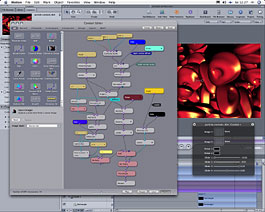
Just today, I was presented with a link from one CG Ray, that revealed to me another piece of software in the long line of competitive budget priced compositing packages. Lacquer's Conduit is a reasonably priced US $199.00 compositor that allows you to integrate with FCP, and Adobe's Creative Suite software and produce results in realtime HD and with 'film-class colour precision.'
For a full run down of features and specifics, head to the website for a gander.
http://www.lacquer.fi/conduit/index.php
Friday, March 14, 2008
Wacom drivers finally fix monitor spanning
One thing that always irked me about using dual monitors and a wacom pad was having to choose between a tablet setup that only worked on the primary monitor and not the secondary, or a setup where the pad worked on both monitors but at the cost of a very sensitive X axis due to the width of the screen span.
Until now I'd relied on applescript to invoke a "monitor switch" if I was wanting to have the wacom jumping between screens - but apparently Wacom's latest drivers as of December 07 have fixed the issue, and you can now map a button that jumps the pad from one screen to the other in an instant! (only if your running a Cintiq, or an Intuos3 though!)
happy tableting!
FBX bits
AutomaticDesk has some bits for Fbx format files, the Quicktime viewer is abit of fun:
http://usa.autodesk.com/adsk/servlet/index?siteID=123112&id=6839916
SEBsky Tools
I know this is not totally relevent to Vfx, but may come in handy one day.
Sebsky Tools is a Freeware application consisting of five utilities, each aimed at helping to move editing projects between Avid Media Composer (Avid) and Final Cut Pro (FCP) made by Apple Computer.
http://www.dharmafilm.com/sebskytools
Thursday, March 13, 2008
Incredible Hulk, Incredible EXCITEMENT!
There was once a time, when two VFX artists shared a small two desk room on Kavanagh Street. The movie of the year was Ang Lee's critically panned, but amazingly awesome The Hulk movie. Desktops revolved around images of the new age 3D Hulk flexing his pecks in humbling manners, a morning scream was usually the result of the tiniest tid-bit of news making it pre-release news hitting the intraweb.
Now it's 2008, and it's all about the re-envisioned INCREDIBLE HULK. Feast your eyes on the above trailer, and prepare yourself from gushing comments of love from Dom. The new 3D Hulk does look mighty fine. Let's hope the VFX holds it's own next to the live action! Bring it on!
Quicktime tip of the day
Hi -
Welcome! First Post Milestone!
Greetings and welcome to The Brains Trust blog page,
